Surprising Things That Go Hack in the Night
Building the Guardrails™ | October 2026
Halloween is my favorite time of year. I enjoy the decorations, the scary movies, and the haunted houses, and, of course, all things compliance.
October is also Cybersecurity Awareness Month, and it highlights a different kind of monster in Compliance. These don’t need costumes, and they aren’t after candy. They want your information, your money, and sometimes your whole business.
Unlike my Halloween decorations, they don’t get packed away on the first of November.
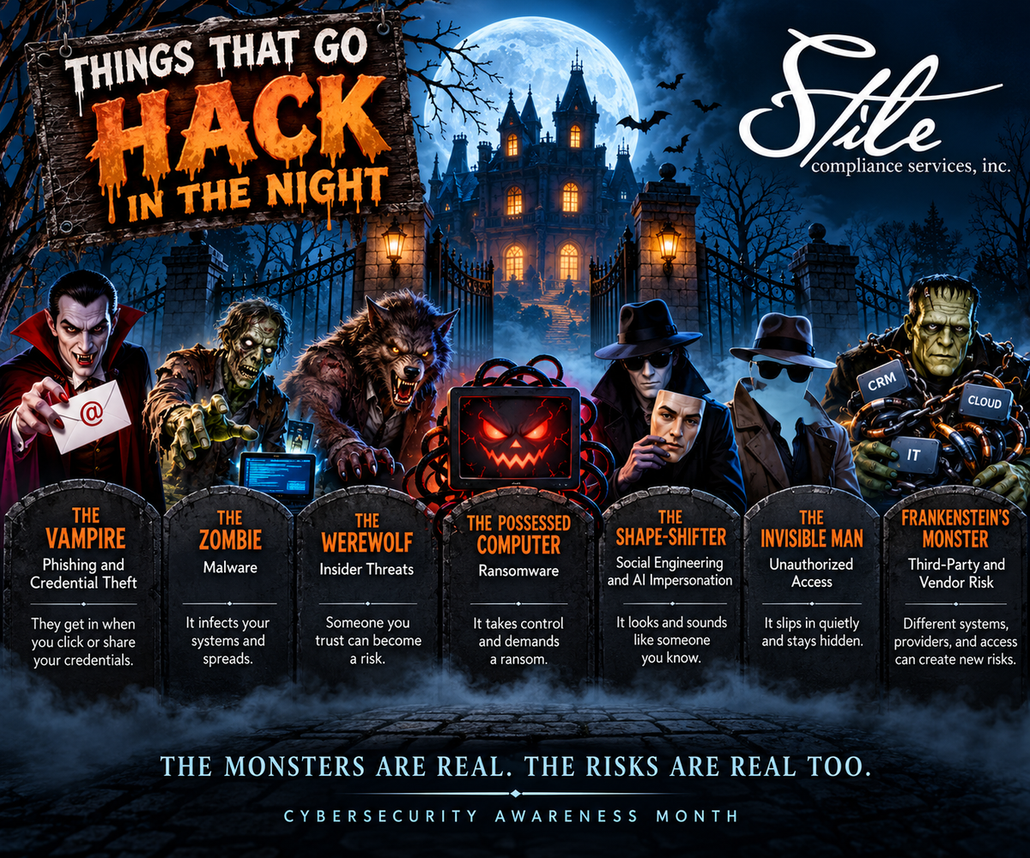
Meet the Monsters
The Vampire: Phishing and Credential Theft
Remember those old vampire movies where the vampire couldn’t enter your home unless you invited him in?
Cybercriminals use much the same trick. They send emails that look like they’re from Microsoft, your bank, a client, or even someone in your office. All they need is for someone to click a link or enter their login credentials. Once that happens, they’ve been invited inside.
Employee training, multi-factor authentication, and verifying unusual requests can help keep the vampires outside.
The Zombie: Malware
We’ve all seen the zombie movies. Someone gets infected, and before long, the infection spreads.
Malicious software works much the same way. An infected computer might keep working normally while it quietly collects information, monitors activity, or communicates with an outside party. Some infections spread to other devices.
Keeping software updated, using endpoint protection, and monitoring systems for unusual activity can help prevent an outbreak.
The Werewolf: Insider Threats
Werewolves look perfectly normal until the full moon comes out. Then someone you thought you knew becomes something entirely different.
Insider threats can be just as hard to recognize. An employee may have legitimate access to sensitive information and systems. But what happens when that employee becomes disgruntled, decides to take confidential information, or makes a mistake that exposes the business? Sometimes the employee isn’t even aware there’s a problem. Their account may have been compromised by someone outside the firm.
Not every insider threat is intentional, but the damage can be just as serious. Limiting access to what employees actually need, monitoring unusual activity, and promptly removing access when someone leaves can help reduce the risk.
The Possessed Computer: Ransomware
In the movies, possession turns something familiar into something frightening. What was once under control suddenly isn’t.
Ransomware can do the same thing to your business. One minute, employees are working, files are accessible, and everything seems normal. The next, systems are locked, files are encrypted, and someone is demanding money to give you back control. Paying the ransom doesn’t guarantee you’ll get your information back. Backups are important, but having them isn’t enough. You need to know they work and that you can restore your systems when you need them.
When was the last time someone actually tested your firm’s ability to restore its information?
The Shape-Shifter: Social Engineering and AI Impersonation
This monster can look like your boss, sound like your client, or send an email that appears to come from your IT provider. Artificial intelligence has made impersonation easier and more convincing. The days when poor grammar and misspelled words were reliable warning signs are largely behind us. Imagine receiving a call that sounds exactly like a client asking you to change banking instructions. Would your employees know what to do?
Verification procedures, particularly for money movements and changes to sensitive information, can help prevent a very expensive mistake.
The Invisible Man: Unauthorized Access
Not every intruder announces their arrival. Someone who obtains legitimate login credentials may be able to access your systems without immediately attracting attention. They might spend days or weeks looking around, collecting information, and figuring out what else they can reach.
That’s why access controls, multi-factor authentication, security monitoring, and periodic access reviews matter. Also, does anyone know whether former employees still have access to any of your systems? It’s worth checking this week.
Frankenstein’s Monster: Third-Party and Vendor Risk
Most businesses rely on a collection of technology providers to keep things running. There’s the IT company, cloud provider, customer relationship management system, document storage provider, and any number of other applications.
Each may be doing exactly what it’s supposed to do. But who’s looking at how all those pieces fit together? Who determines which employees have access? Who reviews security alerts? Who makes sure the responsibilities of one provider don’t end where another provider’s begin?
Outsourcing technology makes sense. Assuming someone else has taken responsibility for everything doesn’t.
The Scariest Monster of All
Many business owners are good with technology. They install software, set up email, and fix problems when they come up. It’s natural to think that same skill covers security. It doesn’t, quite. Keeping your computers running and keeping your business secure are two different jobs.
Someone has to be watching for suspicious activity. Someone has to manage security updates, review access permissions, test backups, and make sure the business can recover from an attack. And someone has to keep up with threats that seem to change almost daily.
None of this means every business needs a full-time IT department. The point is that knowing how to use technology and knowing how to secure it are different skills. A qualified IT professional or managed service provider brings expertise that most owners don’t have in-house. Even then, the owner should understand what’s being done and whether it’s working.
The biggest risk isn’t always the monster trying to get in. Sometimes it’s assuming you already have everything covered.
Building the Guardrails™
We often talk about cybersecurity in terms of three basic functions: prevention, detection, and response.
Prevention is what you do to keep the monsters out. Detection is how you know when one gets inside. Response is what you do once you discover it.
But how do you know whether your business is prepared?
That’s where the four pillars of Building the Guardrails™ come into play:
- Clarity: Who is responsible for each security task?
- Accountability: What exactly are they doing?
- Documentation: How do we know it’s getting done?
- Continuous Improvement: When did we last test whether it works?
I’m not suggesting that business owners become cybersecurity experts or that every possible threat can be eliminated. I’m suggesting something much more practical.
Find one gap. If you can’t answer one of those questions, you’ve found a place to start. Then find the next one.
The monsters aren’t going away when Halloween is over.
Stile Compliance Services | Building the Guardrails™
#CybersecurityAwarenessMonth #Cybersecurity #InvestmentAdvisers #BuildingTheGuardrails